
WILLIAM LEVITT JR.: SWEAT & ENTANGLEMENT
WILLIAM LEVITT JR.: SWEAT & ENTANGLEMENT
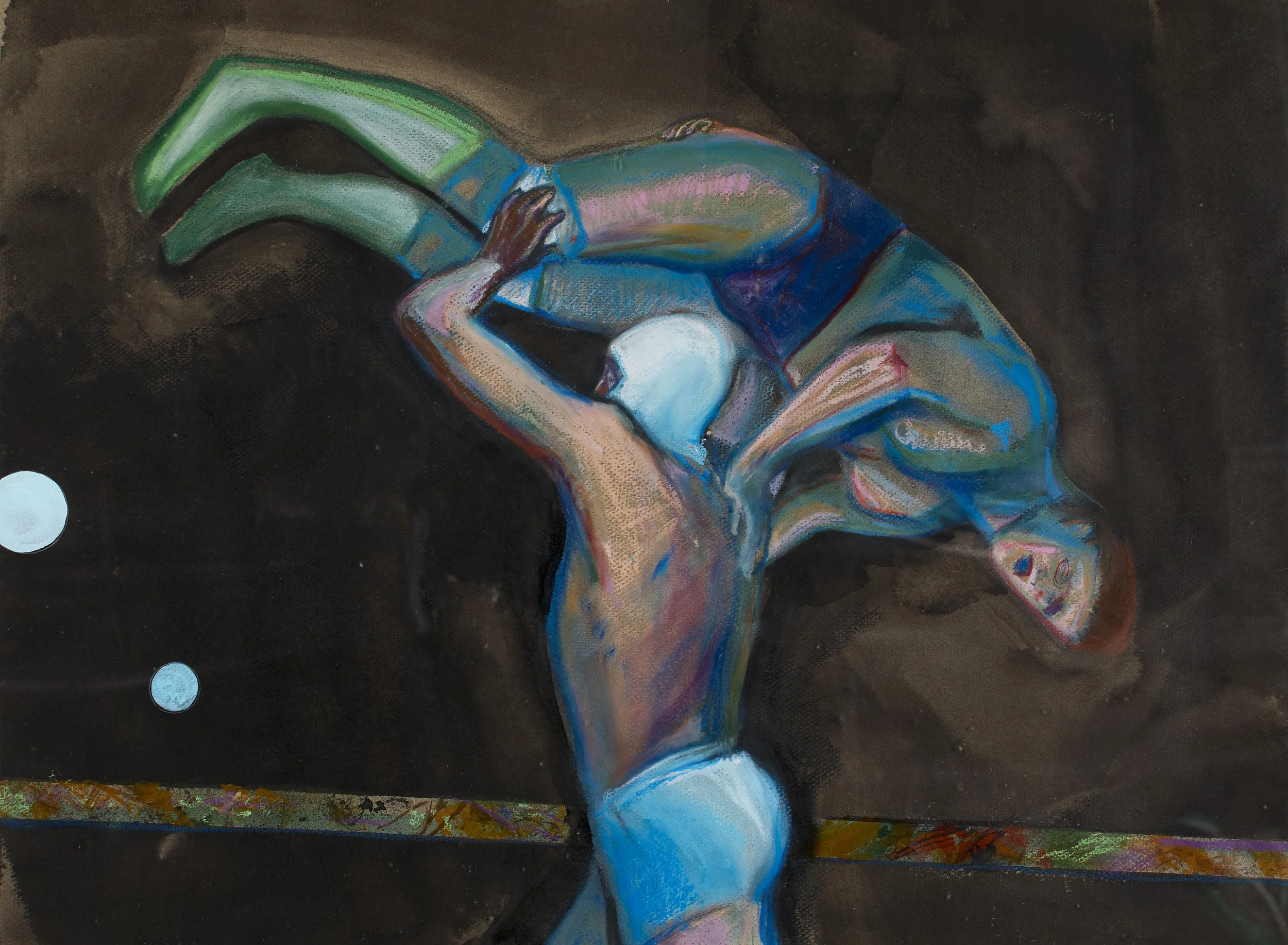
Lot 83 in AFTER DARK/WINTER 2026. Flip. William Levitt Jr. (American, 1941–2015). Oil pastel on paper.
By Barry Oliver
Throughout the history of art, the simple objective of male wrestling, to outmaneuver an opponent by pinning their shoulders to the ground, has provided an adaptable visual structure that has inspired artists for centuries.
In a series of paintings from the 1980s, the American artist William Levitt Jr. (1941–2015) captured the colorful costumes, masks, stylized holds, and maneuvers that define the unique Mexican wrestling form, lucha libre. Levitt Jr. was a longtime resident of the state of Querétaro, whose capital supported a thriving lucha libre culture and a purpose-built stadium, the Arena Querétaro. In Flip, Levitt illustrates the precise moment a luchador executes a flying aerial technique to upend his opponent.
Wrestling is one of the oldest documented competitive sports with its origins traceable to ancient civilizations. Compositions of man-on-man wrestling have preoccupied artists since ancient times as a means to demonstrate their mastery of rendering musculature and anatomically accurate figures in dynamic poses.
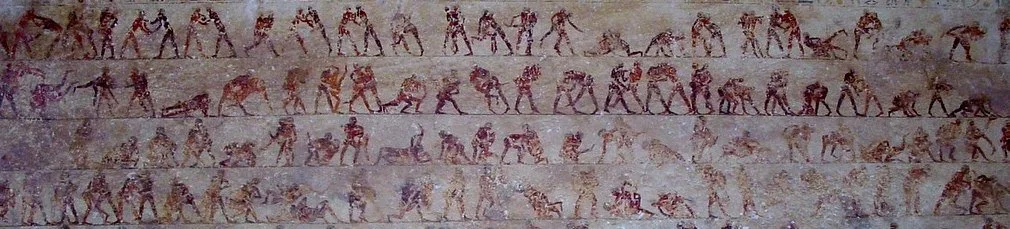
Tomb of Baqet III at Beni Hasan. c. 2000 BCE. Fresco.
Some of the earliest known renderings of wrestling appear on the frescoed walls of the Tomb of Baqet III at Beni Hasan, dating to the Middle Kingdom period (c. 2000 BCE). With over 400 painted scenes depicting men engaged in a wide variety of holds and stances, the tomb constitutes the most comprehensive surviving visual record of ancient wrestling techniques. These images demonstrate that wrestling in ancient Egypt was not merely a form of physical training but a codified sporting tradition emphasizing discipline, balance and controlled violence.
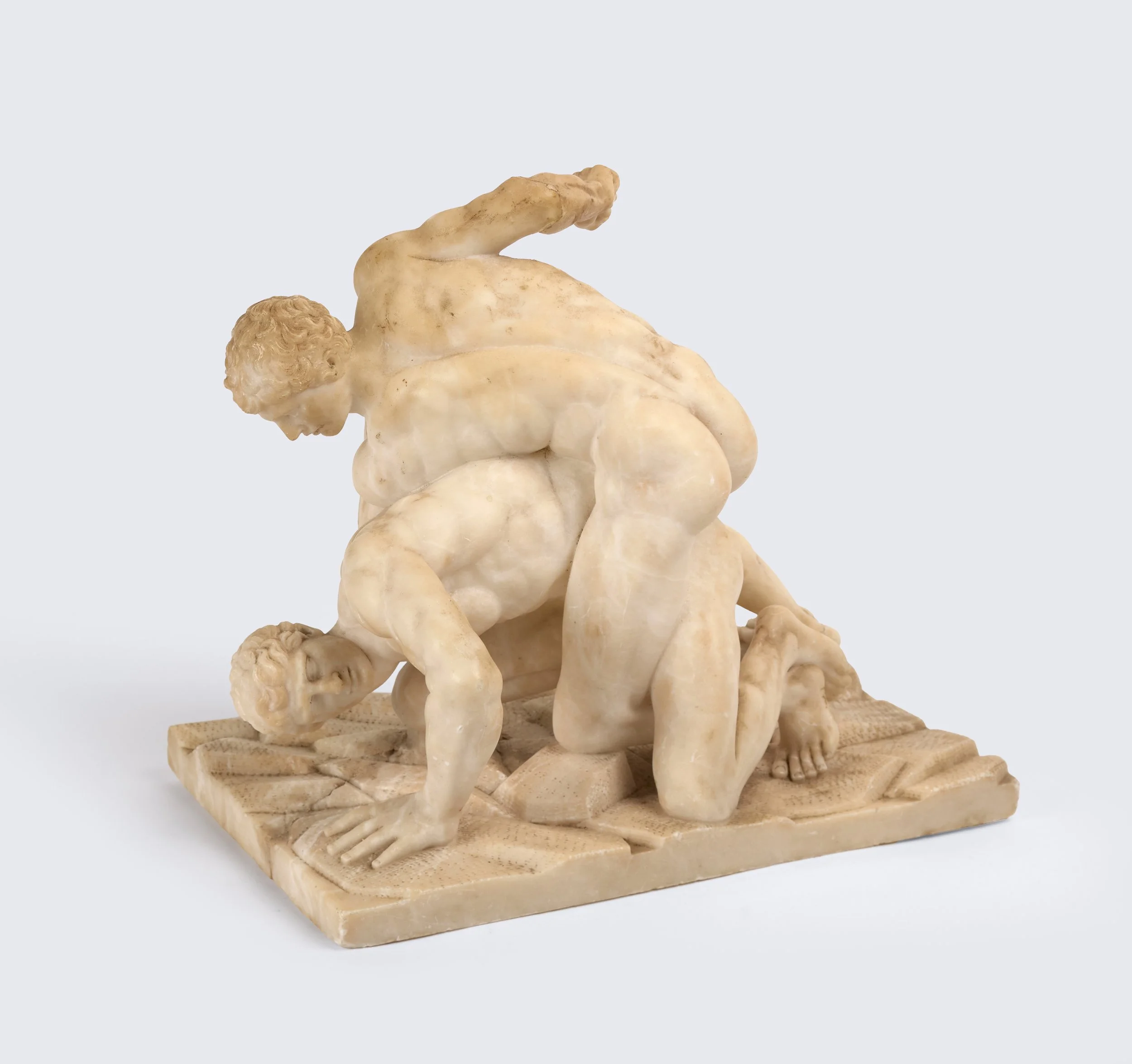
The Wrestlers. 19th-century. Carved alabaster after the Roman marble (housed at the Uffizi Museum). Sold previously at our AFTER DARK/AUTUMN auction.
The skilful depiction of wrestlers reached its apex in the art of ancient Greece, and later Rome, due to the former’s obsession with the perfection of the human body. The ideal male nude, epitomizing physical beauty and strength, was believed to reflect divine harmony. Combat sports such as the pankration, or bare-hand fighting, competitions that took place at the ancient Olympic games provided artists with dynamic compositions to explore anatomy, movement and muscular tension in sculpture.
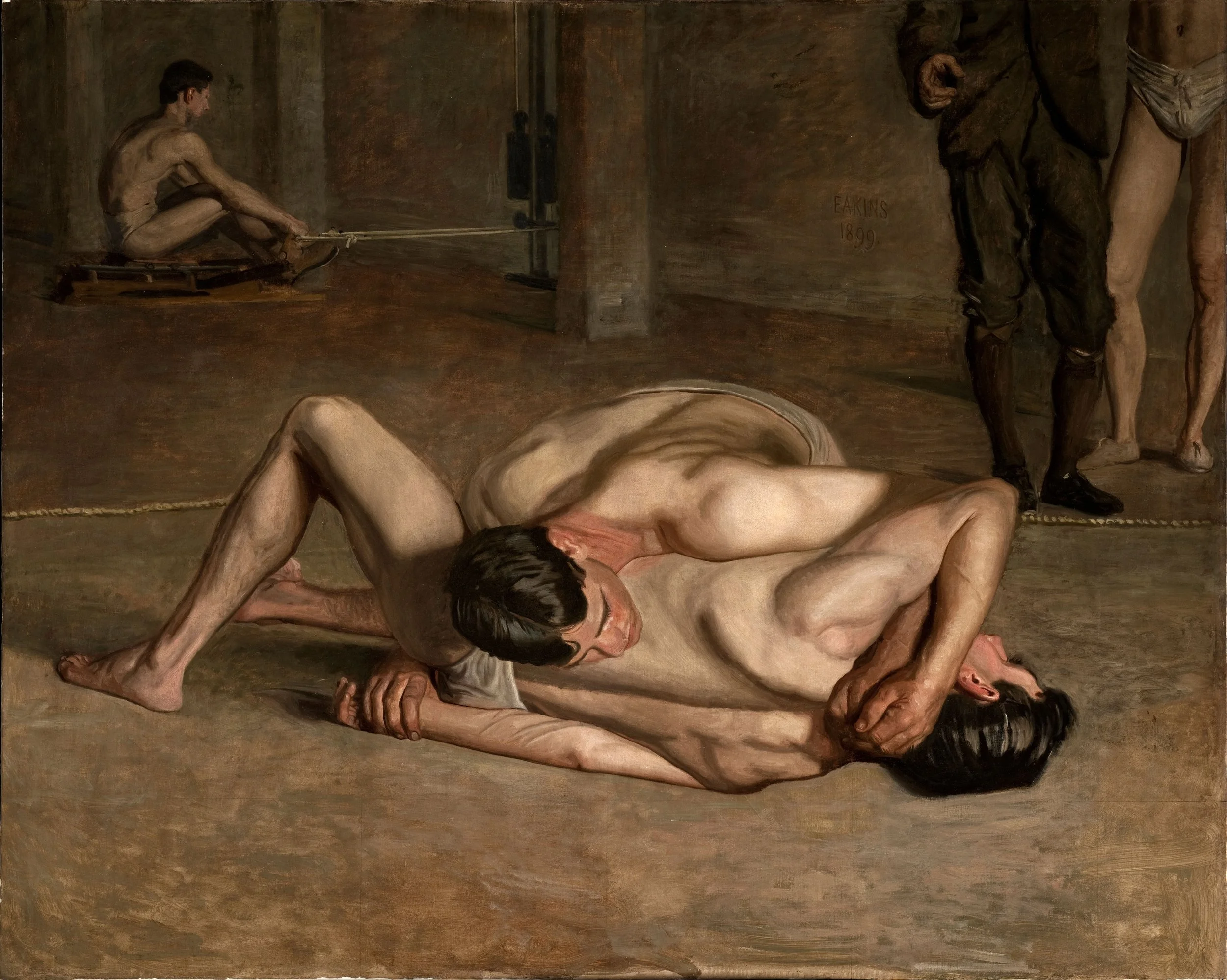
Thomas Eakins (United States, Pennsylvania, Philadelphia, 1844 - 1916). Wrestlers. 1899. Oil on canvas.
By the late 19th century wrestling had acquired complex cultural associations, including a subtle homoerotic charge that is recognizable even to contemporary audiences. The American realist painter Thomas Eakins explored this ambiguity directly in his painting Wrestlers (1899).
Much like William Levitt Jr., Eakins devoted himself to a series of sports scenes beginning in 1898 and focused primarily on indoor boxing and wrestling matches. In Wrestlers, two partially nude young men are shown locked on the floor in the signature “crotch hold” technique used in professional wrestling. Stripped of theatrical spectacle, the scene emphasizes anatomical accuracy, physical strain and the intimate proximity of the bodies, blurring the boundary between athletic contest and sensual encounter.
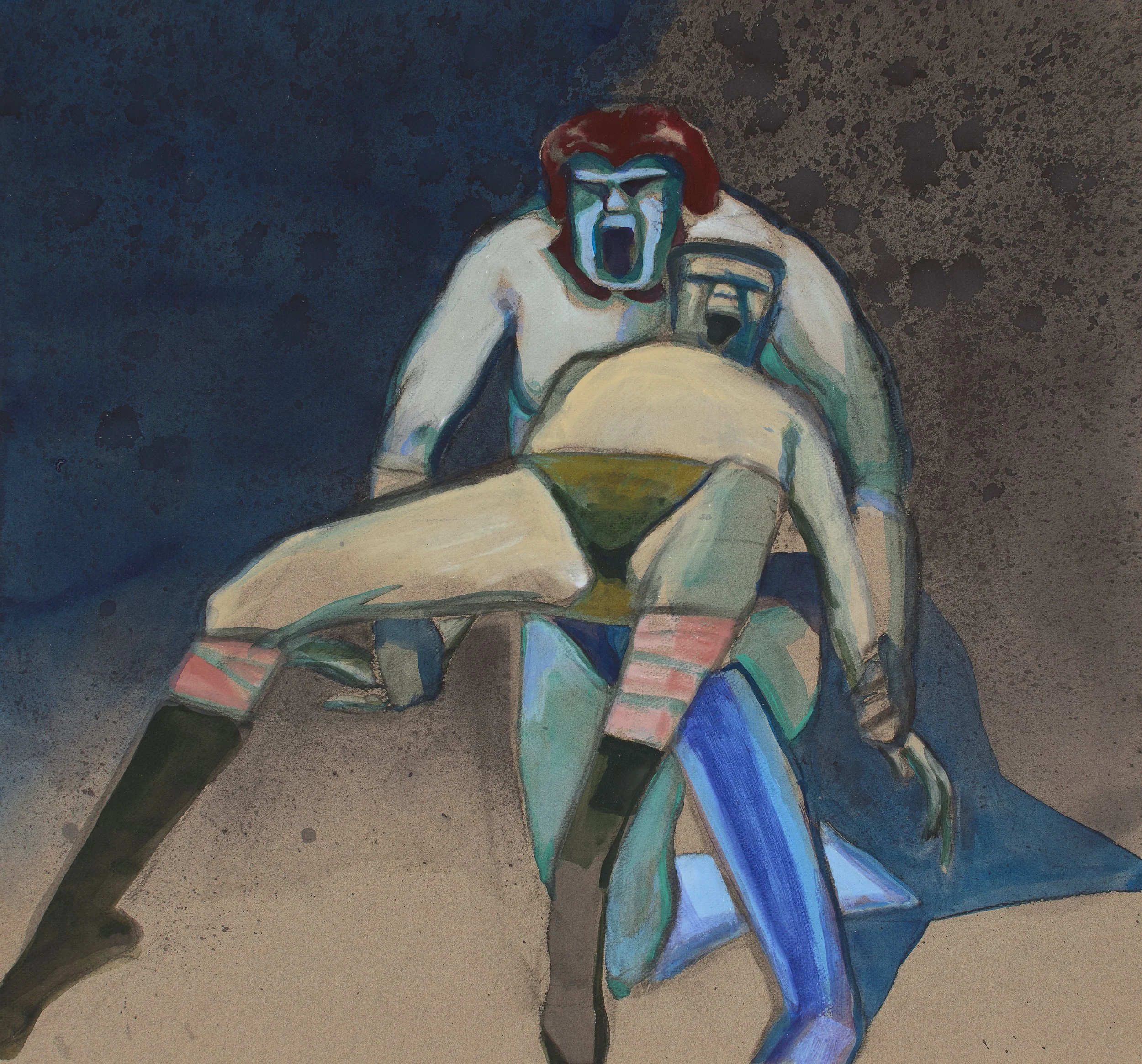
Lot 84 in AFTER DARK/WINTER 2026. Over-the-Knee. William Levitt Jr. (American, 1941–2015). Gouache and pastel on paper.
Unlike traditional wrestling, the modern Mexican sport of lucha libre is not exclusively a sporting competition but has instead evolved into a theatrical spectacle. Loosely meaning “freestyle wrestling”, lucha libre emphasizes narrative storytelling through both individual matches and episodic arcs in a wrestler or luchador’s storied career.
Each participant assumes the role of either hero or villain, técnico and rudo respectively, in scripted matches with predetermined outcomes and winners. Exóticos are male wrestlers who perform with exaggerated feminine self-presentation and expressions, similar to the practice of drag. Reflecting the broader performative nature of lucha libre, the gender-bending exótico character both spoofs and challenges the dominant culture of machismo traditionally expected of Mexican men.
Find a rare selection of William Levitt Jr.’s paintings in our AFTER DARK/WINTER 2026 auction catalog set for February 26th, 2026 at 7PM EST.