
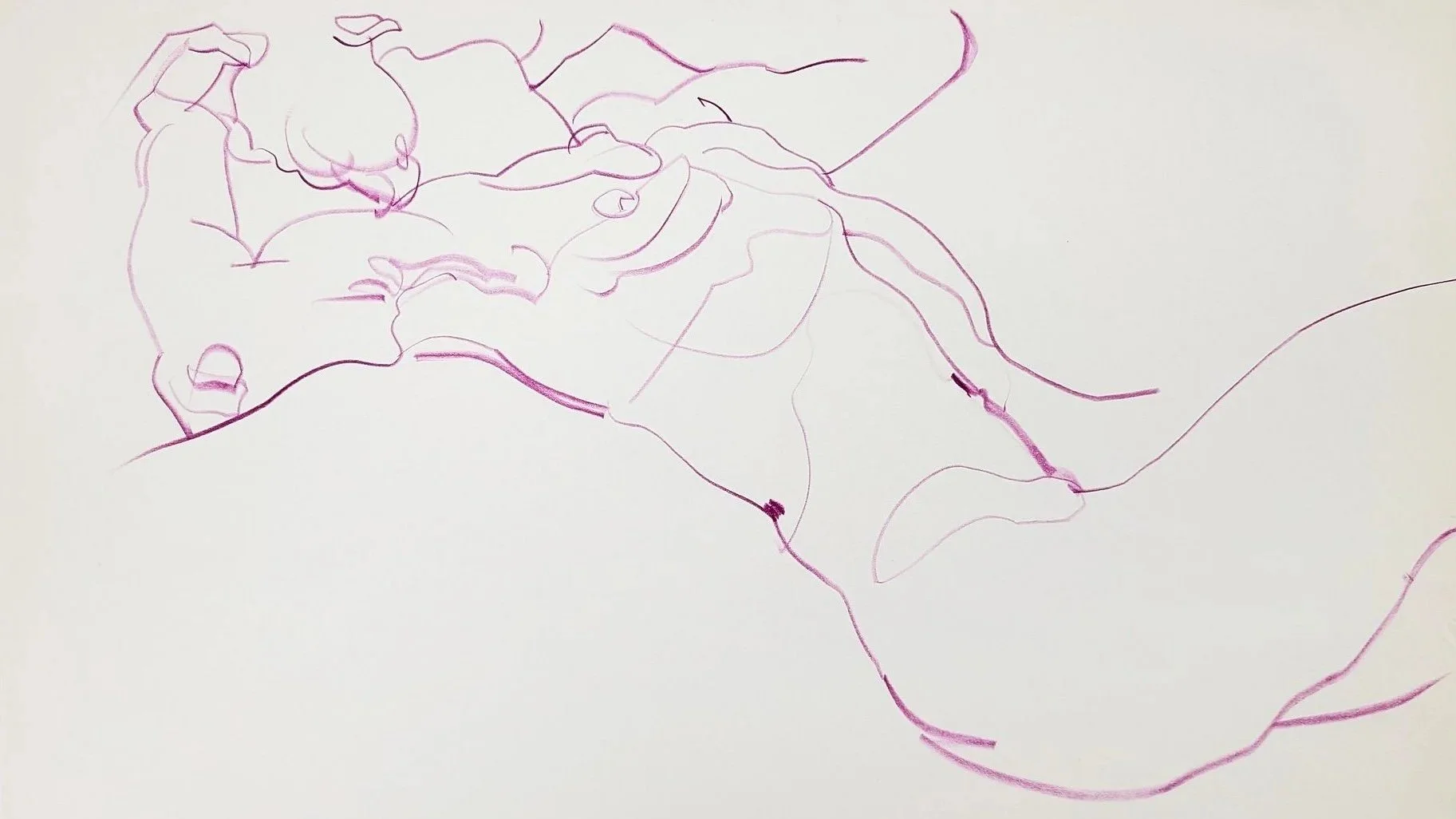
LAURENCE HERBERT SCOTT
AMERICAN, 1933–2005
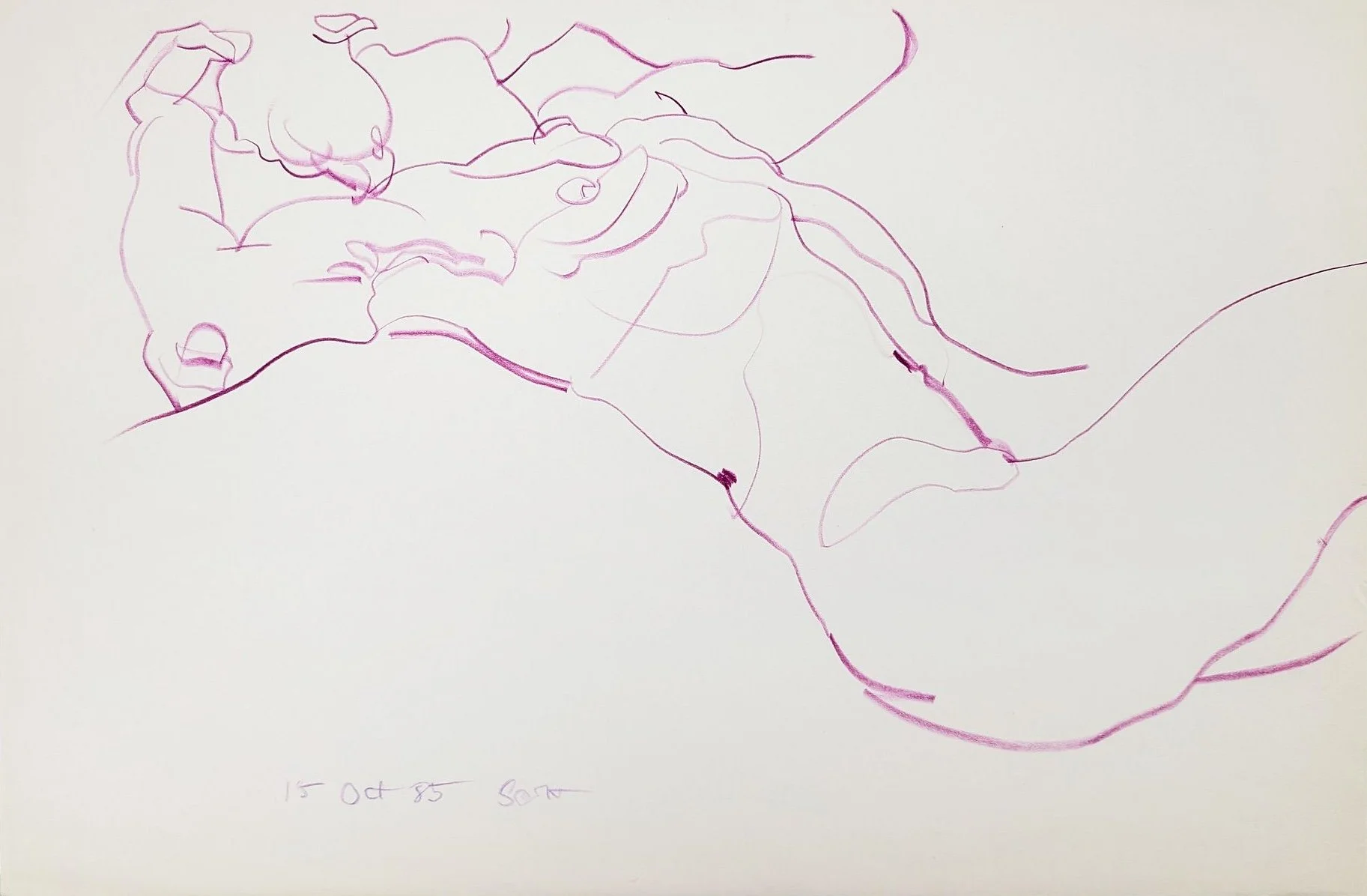
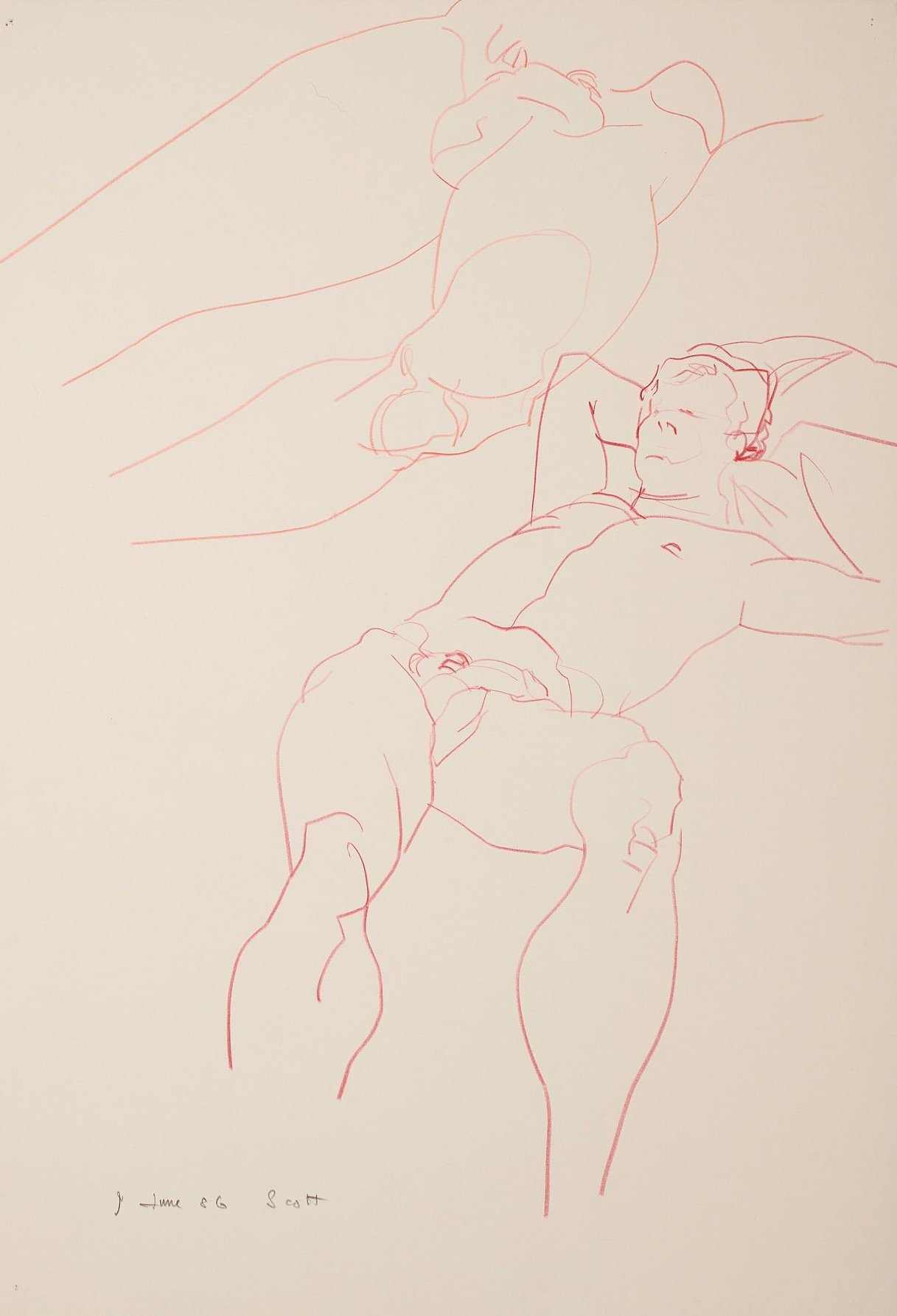
"15 Oct. '85." 1985. Purple pencil on paper. Offered in AFTER DARK on 22 May 2025.
NOTE: The following article is NSFW and includes images of artistic nudity.
Laurence Herbert Scott was born in Detroit in 1933. He was raised in Ann Arbor and graduated from the University of Michigan in 1955. He earned a MA from Harvard University and continued to pursue doctoral work there in Slavic Studies. A consummate polyglot, Scott was fluent in eight languages including Russian, Czech, and Polish.[1]
As an academic, Scott published the definitive English-language translation of Morphology of the Folktale by Russian folklorist Vladimir Propp, a seminal text in literary theory that remains in print to this day.[2] During his Harvard days, Scott was active in literary circles such as the New Poet’s Theater, translating poems from Polish for its journal Fire Exit.[3] He was employed as a teaching fellow in the Department of Slavic Languages and Literature at Harvard. Scott was a tutor at Lowell House, one of the twelve residential houses at the university. He later lectured at Massachusetts Institute of Technology.
While at Harvard, Scott established the Lowell-Adams House Printers which specialized in producing limited-edition broadsides of poems and essays. Compared to the traditional typesetting of publishing houses, the student-run enterprise could experiment in composition and page layout. Students submitted drawings and engravings to complement the written word, and each broadsheet was hand-signed by both the poet and illustrator. Scott personally designed Marianne Moore's poem "W. S. Landor" and his close friend James Merrill's "1939: An American Woman Explores the Estate of Friends Who Have Fled France." The Lowell-Adams House small printing enterprise published broadsheets of the work of Adrienne Rich, Cecil Day Lewis, Howard Nemerov, I. A. Richards, Jack Kerouac, John Updike, and Noël Coward.
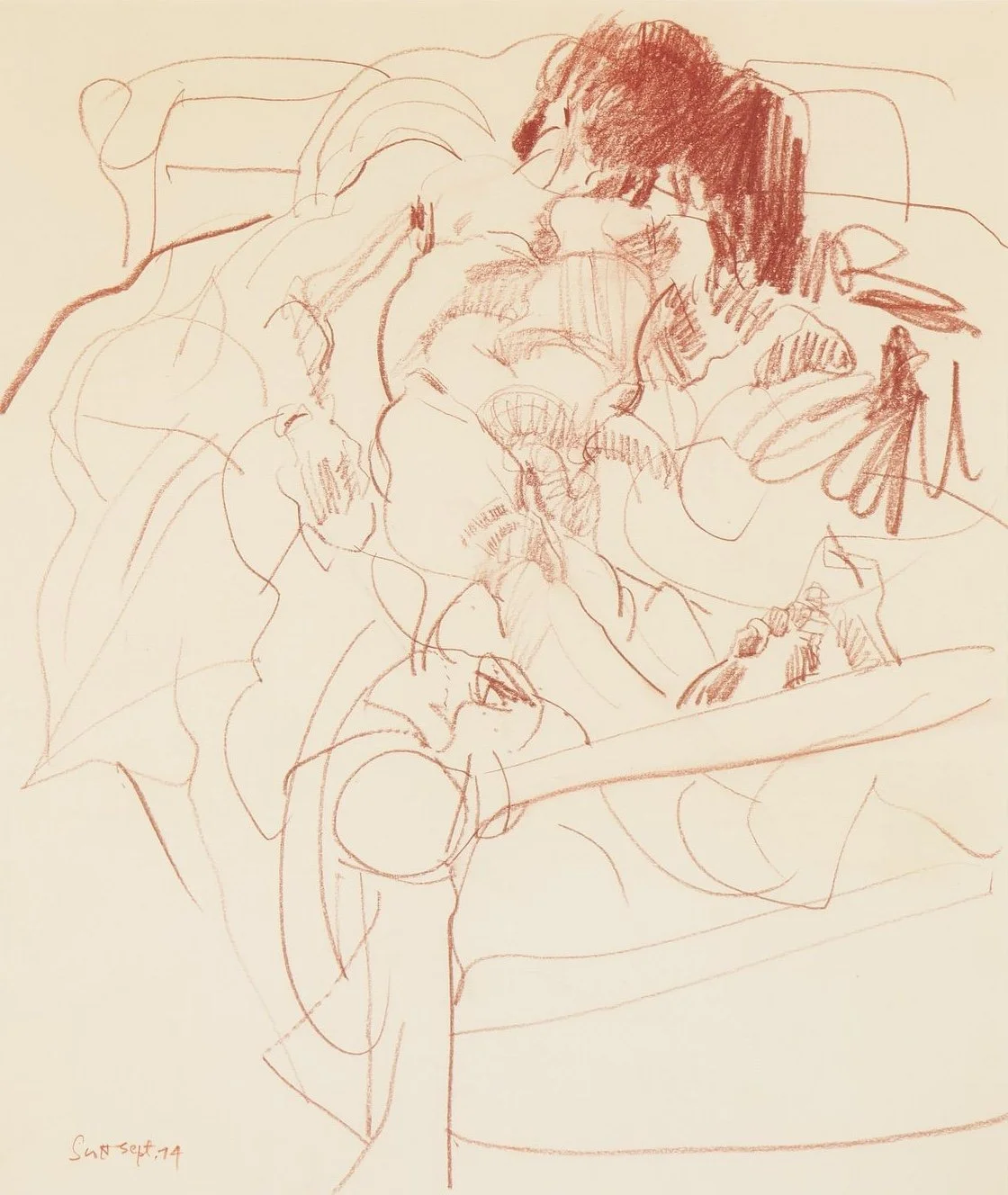
Laurence Herbert Scott. Untitled. Colored pencil on paper. 1974. Offered in AFTER DARK on 18 January 2024.
In 1966, Scott founded the Ibex Press to publish and engrave exclusive collections of poetry by Allen Ginsburg, Hart Crane, Robert Lowell, and W. H. Auden. Hors commerce copies were reserved as donations to libraries. Outside of his small press activities, Scott illustrated issues of The New Yorker and The New Republic.
To say that Scott was well connected would be an understatement. In a letter to the literary scholar Hugh Kenner, his Harvard friend Guy Davenport claimed that Scott simply “knows everybody."[5]
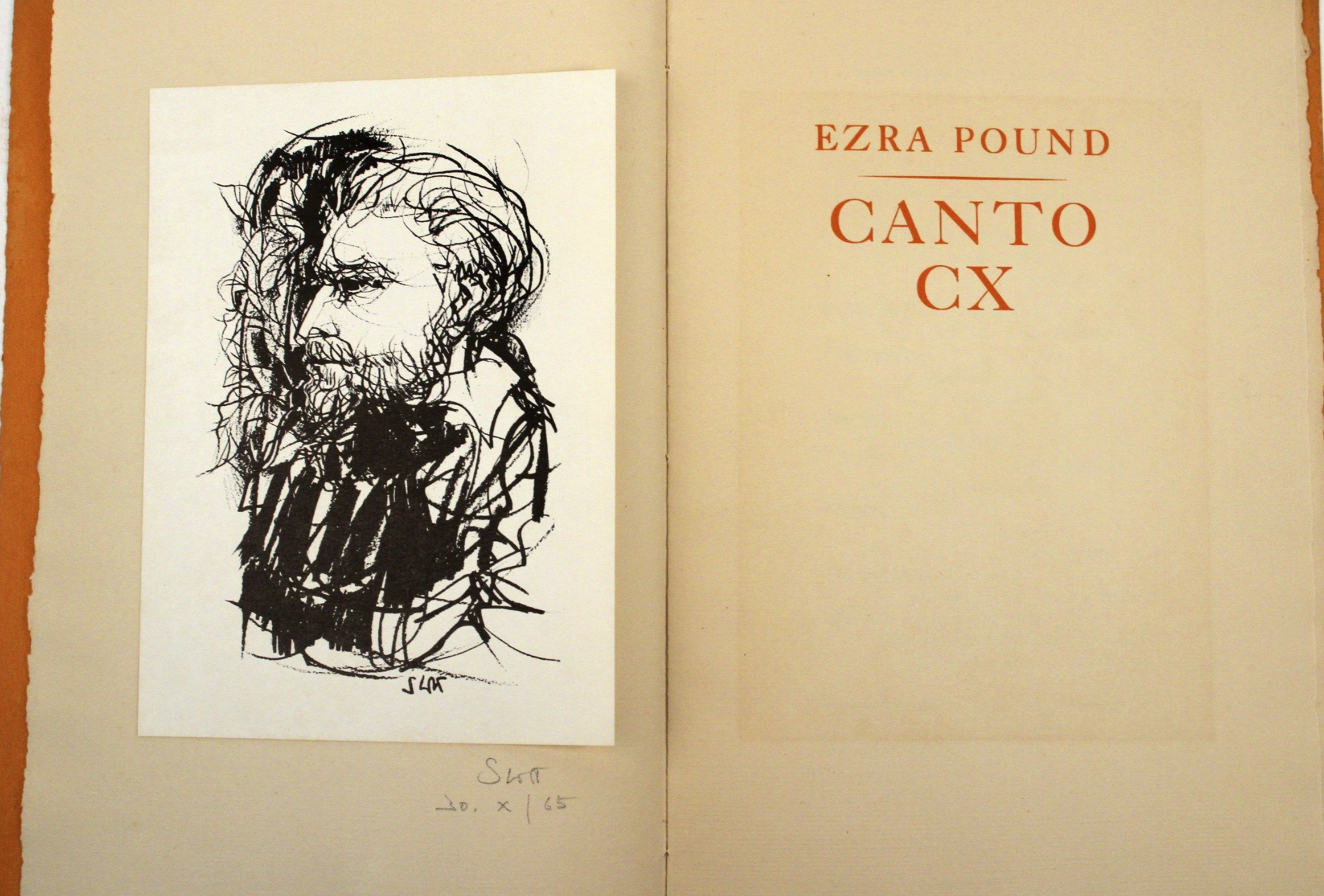
Laurence Herbert Scott. Illustration for Ezra Pound’s “Canto CX”.
On a whim, a sixteen-year-old Scott sent the modernist poet Ezra Pound a copy of an illustration he designed for the cover of a local magazine. To his surprise, Pound responded. From high school through his university days, Scott received literary and philosophical recommendations from Pound by correspondence.[4] Guy Davenport, the celebrated writer and painter, and Scott teamed up to publish the first edition of Pound’s Canto CX in 1965 under the imprint As Sextant Press. Scott created and engraved Pound’s portrait frontispiece and printed 118 copies, 80 of which were gifted to the poet on the occasion of his 80th birthday.[6]
Scott maintained a close working relationship with the American poet Marianne Moore, whom he assisted with the translation of the Fables of La Fontaine. Alongside the American artist Peggy Bacon, Scott created the animal engravings used to illustrate her festschrift, an album of essays and poems commemorating Moore.[7] Through her, Scott became acquainted with literary giants such as T. S. Eliot.
Scott engaged in various forms of political activism during his teaching career at Harvard. He attended anti-war ‘be-ins’ on the Cambridge Common in protest of the Vietnam War. In 1973, alongside gay and lesbian rights groups, Scott picketed the conference of the American Psychiatric Association (APA). At the time, the APA classified homosexuality as a pathological affliction, and the action taken by protestors such as Scott led to a successful resolution removing the classification from the Diagnostic and Statistical Manual of Mental Disorders. Scott was an active figure in his hometown Ann Arbor’s chapter of the Gay Liberation Front. As an out gay man, Scott was a fixture on the Boston queer scene and had connections with Charley Shively and John Mizel who led the Fag Rag collective that printed one of the first national non-news focused newspapers for gay men.
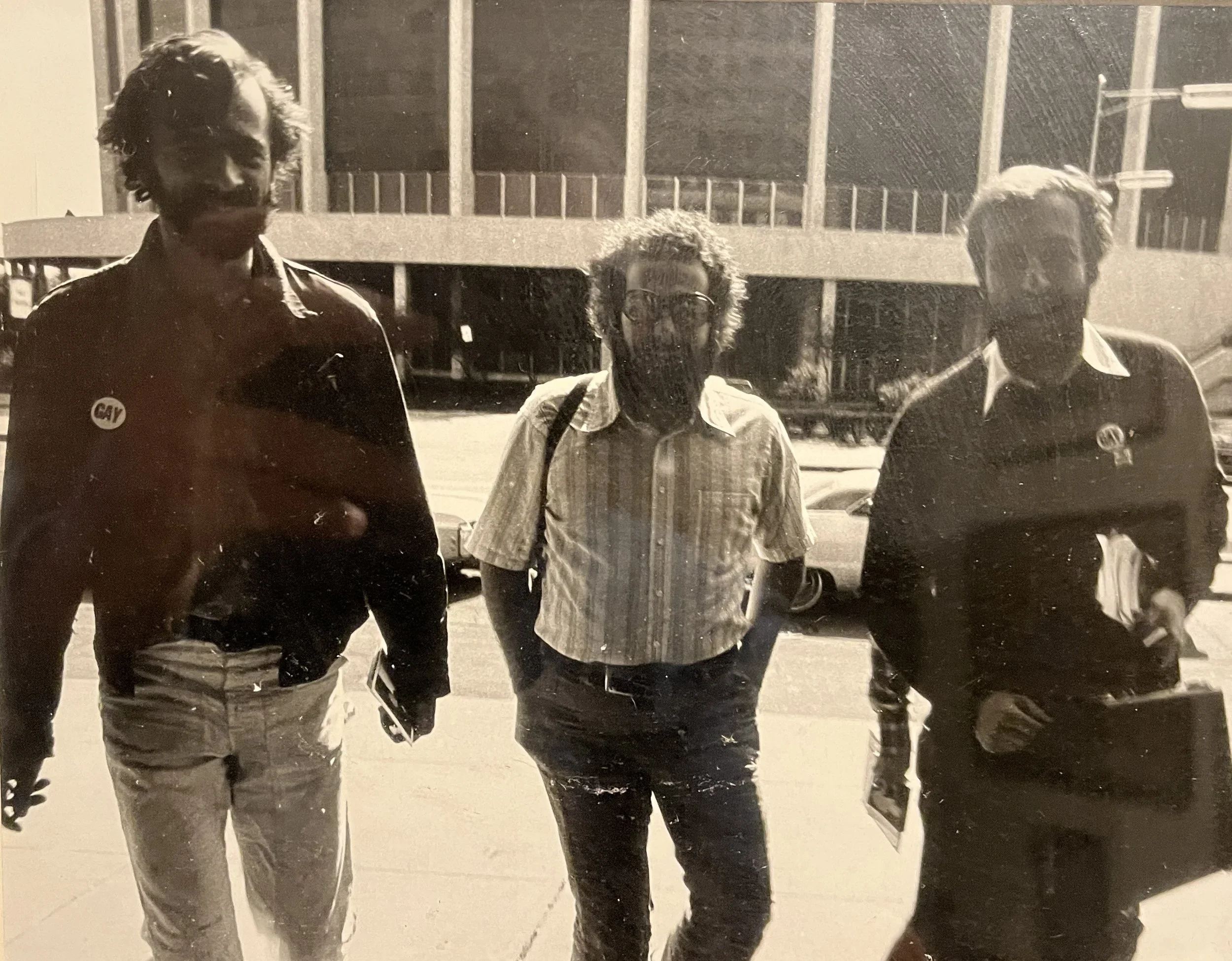
Peter Gillis (left), Harry ‘Kitty’ Kevorkian (center) and Laurence Herbert Scott (right). Picketing at the American Psychiatric Association Conference in 1973.
With Harry ‘Kitty’ Kevorkian and his life partner Gerald G. Naylor, Scott co-founded the first pro-feminist gay liberation group in the United States.[8] Originally called the Male Liberation Collective, the organization changed its name to the Basic Education Project (BEP) to distance itself from the heterosexual men's movement that was gaining traction in the early 1970s. The main political activities of the BEP comprised the distribution of feminist literature and anti-sexist reading lists, the provision of consciousness-raising sessions, and personal counseling for closeted and politically disengaged gay men.[9]
The BEP was closely aligned with the first radical feminist organization established in the Boston area, Cell 16. Both organizations pioneered a self-defense program by running karate lessons for gay men and women who faced violence and discrimination in the streets.[10] Scott counted some of the founding members of Cell 16 as friends, including Abby Rockefeller, Jane West, and Betsy Warrior.
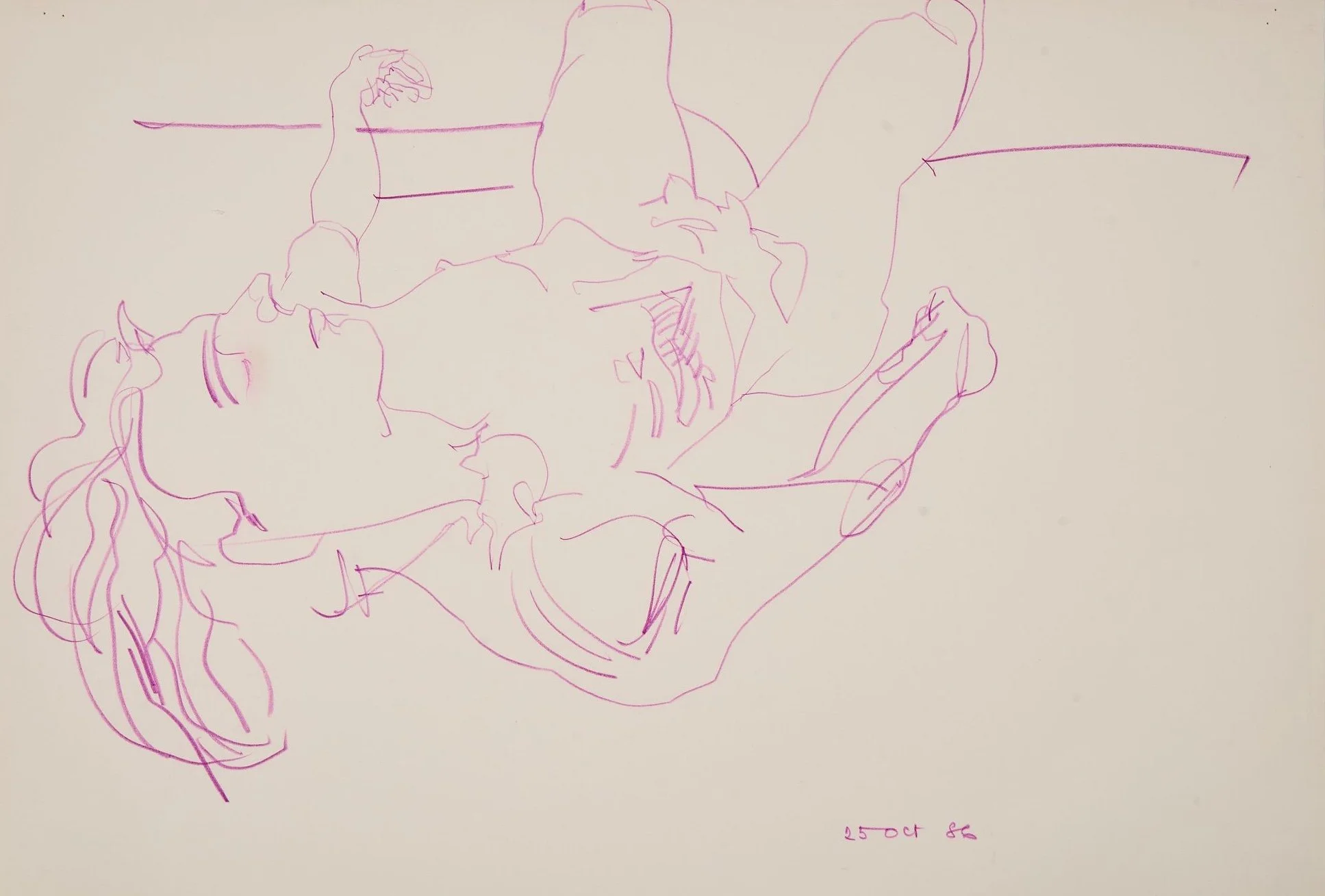
Laurence Herbert Scott. Untitled. Colored pencil on paper. 1986. Offered in AFTER DARK on 31 October 2024.
Scott lived as an openly queer artist when such disclosure could involve considerable personal and professional risk. Through his extensive networking in literary circles and career as a publisher, Scott was a visual artist whose practice was structured around the principle of collaboration. His art was personal, cultivating both intellectual and intimate relationships, and leaving a lasting impression as a mentor and friend on others along the way.
Further Reading
The Peter Gillis Collection: The Male Nudes of Laurence Herbert Scott
by Barry Oliver, Cataloger, LGBTQ+ Art & Material Culture
Notes
[1] Edward M. Burns, ed., Questioning Minds: The Letters of Guy Davenport and Hugh Kenner (Berkeley, CA: Counterpoint, 2018), p. 56.
[2] Simon J. Bronner, American Folklore Studies: An Intellectual History (Lawrence, KS: University Press of Kansas, 1986), pp. 113-114.
[3] Jan Onopa, “My Hands”, trans. Laurence Scott, Fire Exit: The Magazine of the New Poet’s Volume 1, Issue 2 (1968), p. 17.
[4] Tod Marshall, “‘Ten Cats Your Score: Verrrrry Good’: an Ezra Pound Correspondence Course", Paideuma: Modern and Contemporary Poetry and Poetics Vol. 28, No. 1 (Spring 1999), pp. 135-148.
[5] Edward M. Burns, ed., Questioning Minds: The Letters of Guy Davenport and Hugh Kenner (Berkeley, CA: Counterpoint, 2018), p. 316.
[6] Donald Gallup, “Corrections and Additions to the Pound Bibliography”, Paideuma: Modern and Contemporary Poetry and Poetics Vol. 1, No. 1 (Spring/Summer 1972), p. 116.
[7] Tambimuttu, ed., Festschrift for Marianne Moore's Seventy Seventh Birthday (New York: Tambimuttu & Mass, 1964).
[8] “Harry Kevorkian, Ann Arbor gay and labor activist, dies at 54”, Between the Lines 28 (21 February 2002), p. 10.
[9] “who what when where”, The Gay Liberator 28 (July 1973), p. 10.
[10] Alice Echols, Daring to Be Bad: Radical Feminism in America, 1967-1975 (Minneapolis: University of Minnesota Press, 1989), p. 158.
Contributors
Barry Oliver
Cataloger, LGBTQ+ Art & Material Culture
NOTABLE LOTS
Click the lot image for more information